Beauty Wellness Convergence
Beauty Wellness Convergence: The New Hospitality Playbook
Somewhere along the way, the wellness suite stopped being where you went to rest, and became where you went to look different when you left. Nobody announced the shift. This is beauty wellness convergence in real time — beauty and wellness aren’t adjacent categories courting each other anymore, they’ve merged. And the delivery channel for that merger isn’t a beauty brand. It’s a hotel.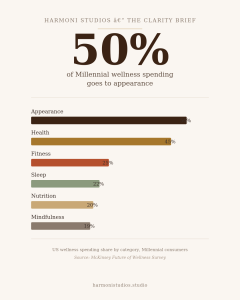
The Data Behind the Beauty-Wellness Shift
Start with the numbers, because they explain why this isn’t a mood — it’s a spending pattern. McKinsey’s Future of Wellness research tracks consumer spending across six wellness dimensions, and one category consistently leads: appearance. Half of Millennial wellness spending and 45% of Gen Z spending goes toward cosmetic procedures, hair care, and skin care — outpacing fitness, nutrition, sleep, and mindfulness combined in relative share. The generation driving the wellness economy is, functionally, driving the beauty economy. They were never separate line items to begin with.
Worth naming plainly: this dataset covers a handful of mature markets and leaves out India, Mexico, and Southeast Asia — three of the exact regions where Harmoni has been building coverage. That’s not a flaw in the research. It’s a gap in the map, and it’s the reason a studio with reach into those markets has something to say that the standard consumer report doesn’t.
Where Beauty-Wellness Convergence Is Actually Happening: The Hospitality Floor
The clearest evidence isn’t in a lab or a lookbook. It’s on the ground, at properties that have quietly repositioned the wellness stay as a beauty outcome.
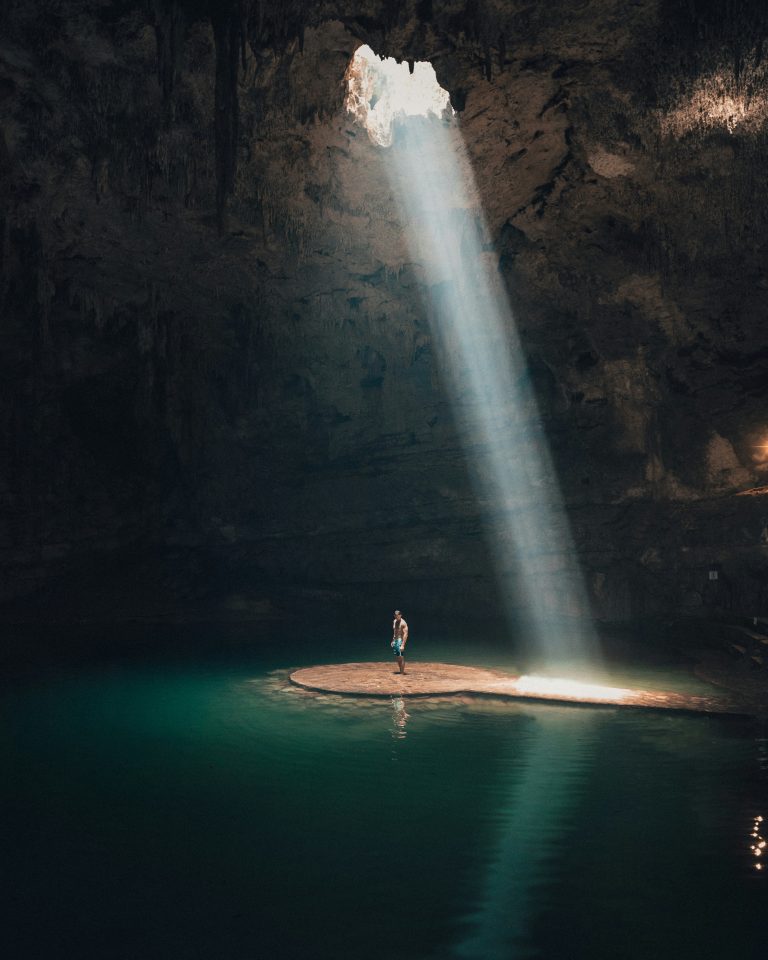
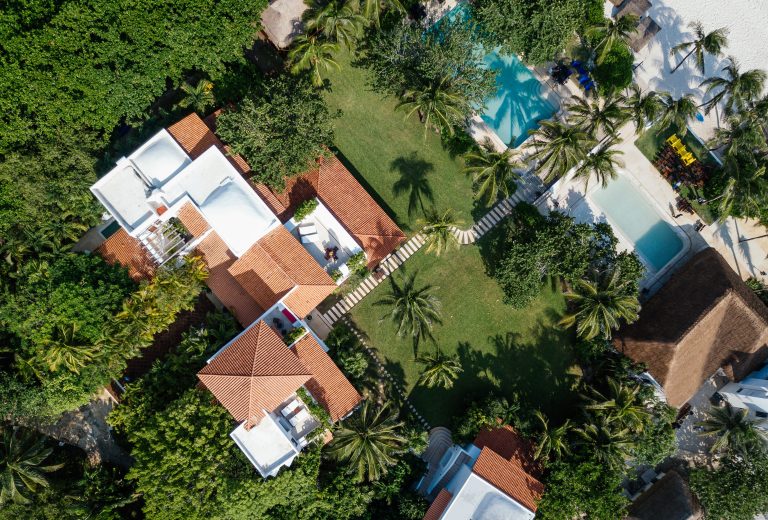
Hotel Esencia, on the Riviera Maya, doesn’t market its spa as a place to unwind — it markets an experience with visible, photographable results, styled and sequenced the way a beauty editorial would be. SHA Wellness Clinic, paired with Almare Luxury Collection, goes further: clinical wellness protocols wrapped in the same outcome-language a skincare brand would use — renewal, radiance, transformation. Neither property calls itself a beauty destination. Both are functioning as one.
This is the tell. When hospitality brands start competing for the same consumer intent as beauty brands — not “help me relax” but “help me look like I’ve been somewhere that changed me” — the category lines have already dissolved. The hotel didn’t become a spa. It became a delivery mechanism.
The Cultural Root of Beauty-Wellness Convergence
Here’s what makes this more than a hospitality trend story: the West is catching up to a framework Japan and Korea have operated inside for decades.
Japanese beauty philosophy has never separated what you apply from what you ingest — the collagen drink that’s sat on Tokyo pharmacy shelves since the mid-2000s wasn’t wellness marketing, it was maintenance, taken with the same unremarkable regularity as a multivitamin. Korea arrived at the same convergence through hanbang, its traditional herbal medicine practice, where appearance and inner health were never philosophically distinct in the first place. Both cultures treat beauty as infrastructure — something maintained quietly over years — not intervention, something that announces itself in a before-and-after.
What’s happening in luxury hospitality right now is that infrastructure logic finally reaching a Western consumer, minus the decades of cultural context that made it make sense in the first place. The wellness retreat is the West’s translation of a practice Asia never needed to translate for itself.
The Bridge Product: How Ingestible Beauty Fuels the Convergence
If hospitality is the delivery channel, ingestible beauty is the bridge — the physical product category that proves the convergence is real and not just an aesthetic. Collagen, taken internally for a topical outcome, only makes sense as a category once you’ve accepted that beauty is something the body does, not something applied to its surface. That’s the same logic now underwriting the wellness-clinic-as-beauty-destination model. The drink stick and the retreat suite are the same argument in two different formats.
The Export Lane: Packaging Beauty-Wellness Convergence for Luxury Travel
This is where Harmoni’s standing framework earns its keep. The culture lane — what Japan and Korea actually practice, and what a property like SHA is genuinely rooted in — is patient, consistent, unremarkable by design. The export lane is what gets sold to a traveler with five days and a camera: compressed timelines, dramatic before-and-afters, a narrative of transformation that the original practice was never built to promise.
None of this makes the export lane dishonest. It makes it a translation — and like any translation, something is always lost crossing over. The luxury traveler buying a week at a wellness clinic isn’t wrong to want the outcome. She’s buying a compressed, aestheticized version of something that, in its country of origin, unfolds over years rather than days.
What Hana Sees: The Beauty-Wellness Convergence, Named
The story here isn’t that hotels added spa menus. It’s that the entire category boundary between “where you stay” and “how you look” has quietly dissolved — driven by a generation whose spending data was already telling us appearance and wellness were never two budgets, just one. Luxury hospitality got there first because it had the infrastructure to sell an experience, not just a product. The rest of the beauty industry is still catching up to its own consumer.
Sources & credit:
- McKinsey & Company — Future of Wellness Survey (US consumer wellness spending by generation)
- Harmoni Studios internal research — Studio Signal 007, “Beauty Was Always an Inside Job: How Japan and Korea Built the Category the West Is Just Now Discovering”
- Field reporting and photography — Hotel Esencia, Riviera Maya (Harmoni Studios, Global Lens)
- SHA Wellness Clinic & Almare Luxury Collection — property research, Harmoni Studios Travel & Wellness