Casa Marianas: Digital Nomad
The Digital Nomad Base No One’s Talking About Yet
The first time I heard the phrase “digital nomad hub” attached to a U.S. commonwealth, I stopped scrolling. Not because it was loud. Because it wasn’t. This wasn’t a press release chasing attention — it was a quiet island economy making a calculated bet on a category most of the world hasn’t priced in yet.
That’s how I found Casa Marianas.
The Discovery
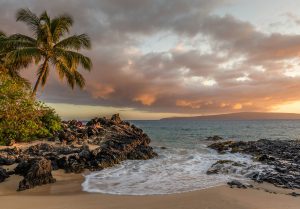
Every so often, a place surfaces that isn’t trying to compete with the usual digital nomad map — Lisbon, Bali, Mexico City — because it was never meant to. Casa Marianas, tucked into the refreshed Gold Beach Hotel in Saipan, isn’t asking to be compared. It’s proposing something the current map doesn’t have a category for: an American remote worker base built for Pacific-Asia proximity, not distance from it.
Saipan sits roughly four hours by air from Seoul, Tokyo, Manila, and Hong Kong — served year-round by direct flights, including United’s nonstop route from Tokyo and Jeju Air’s direct service from Seoul. For a digital nomad working U.S. hours, holding U.S. currency, operating under U.S. law — that’s not a footnote. That’s the entire value proposition.
Why This Is an Export, Not Just a Destination
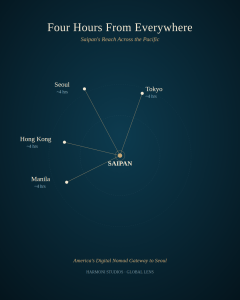
Most travel coverage treats a new nomad hotspot as a place to visit. That’s the wrong lens here. What Saipan is actually exporting isn’t hospitality — it’s optionality. No visa maze. No currency conversion. No re-learning a legal system. Just a U.S. commonwealth positioned as the West’s own gateway into the Pacific-Asia sphere, at a moment when that sphere is pulling more global attention than almost anywhere else.
This is the culture-lane-versus-export-lane split in its clearest form. Internally, Saipan has spent years absorbing typhoons, tourism slowdowns, and hotel closures — a local economy under real pressure. Externally, that same pressure produced a pivot: the July 2025 CNMI Foreign Corporation Promotion Act, legislation explicitly built to package the Commonwealth as a trade and investment hub for the outside and nomad world. Casa Marianas is the private-sector expression of that public bet.
What “New Luxury” Looks Like Here
There’s no infinity pool doing the talking in this story. The luxury is structural: the ability to work from a U.S. commonwealth, four hours from Seoul, without surrendering the stability that usually gets left behind when nomad life begins. Casa Marianas, co-founded by Blaine Graboyes and Gold Beach Hotel’s Kevin Tang, was built around exactly that trade-off — long-stay resident rooms, private offices, a startup-friendly community, and a “Founders Floor” limited to the space’s earliest fifty guests, each one commemorated rather than anonymous.
It’s a small detail, but it says something larger: this isn’t a hotel chasing a trend. It’s a house being built around the first people willing to bet on the idea before anyone else does.
Why Now
Casa Marianas opened its doors in December 2025. Its first digital nomad guests, a couple who traveled from London, arrived only months ago. That timing matters. This isn’t a mature destination with a settled reputation — it’s a category being created in real time, in a part of the Pacific most Western coverage has never pointed a camera at.
Digital nomad culture built its identity chasing distance. Saipan is quietly proposing the opposite: proximity, without giving up home.
— Hana, The Studio’s Eye