Wellness Takeover:
The wellness takeover is no longer a trend line. It is a spending pattern, an identity marker, and a trust test. McKinsey’s Future of Wellness 2027 report, published November 3, puts the global market at $2.7 trillion. This brief reads the data and says what it means.
The Wellness Takeover in Brief
- Wellness now ranks second among consumer priorities, behind family.
- More than a third of US consumers say it is core to who they are.
- Effectiveness ties price as the top buying factor.
- AI is widely used for wellness, but people still drive purchases.
Wellness Takeover by the Numbers
McKinsey surveyed more than 10,000 consumers across China, Germany, the UK, and the US. Its headline figures:
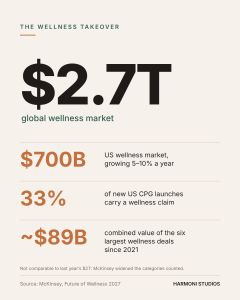
- $2.7 trillion global market. McKinsey notes this is not comparable to last year’s $2 trillion, because it widened the categories counted.
- $700 billion in the US, growing about 5 to 10 percent a year.
- 33% of new US CPG launches through September carried a wellness claim, up from 24% in 2021.
- 53% of the fastest-growing CPG brands are built around health and wellness, more than double the share among slower-growing brands.
- ~$89 billion combined value of the six largest health and wellness deals since 2021. All six were announced or closed in 2025 or later.
Wellness Takeover and Identity
In an interview with Glossy, McKinsey partner Anna Pione said 38% of US consumers call wellness a core part of their identity. She compared the behavior to luxury signaling and said the two coexist rather than compete. Wearables, athleisure, and run-club membership are the visible badges.
Wellness Takeover Across Generations
Gen Z and millennials still lead spending. The shift is among baby boomers: the share who prioritize wellness climbed 11 points to 49%. About 30% of US consumers want to operate at their peak, and over 40% say they would do whatever it takes to live as long as possible.
Wellness Takeover: The Five Consumer Segments
| Segment | % of consumers | % of spend |
|---|---|---|
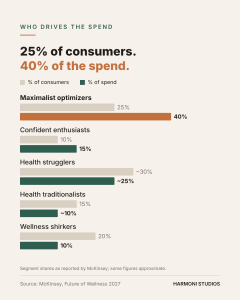
| Maximalist optimizers | 25% | 40% |
| Confident enthusiasts | 10% | 15% |
| Health strugglers | ~30% | ~25% |
| Health traditionalists | 15% | ~10% |
| Wellness shirkers | 20% | 10% |
Wellness Takeover: The Segment to Watch
Health strugglers are the fastest mover. The share prioritizing wellness nearly doubled since 2024, from 13% to 24%. Pione credited the combination of GLP-1 medications and generative AI search for making a once-disengaged group feel able to navigate their health.
Wellness Takeover and the Proof Economy
Effectiveness now ties price as the top overall buying factor. The biggest spenders, maximalist optimizers and confident enthusiasts, rank effectiveness and quality above price. A separate McKinsey Health Institute survey of New Yorkers found that high-spending consumers were 11 points more likely to buy a longevity product that came with evidence.
The gap is real. Around 40% of consumers globally say current offerings still fall short in longevity, mental health, and mobility. Those gaps have held steady since 2024.
Wellness Takeover and the AI Trust Gap
- More than half of consumers use AI for wellness. Among US maximalist optimizers it is 84%, against 29% of wellness shirkers.
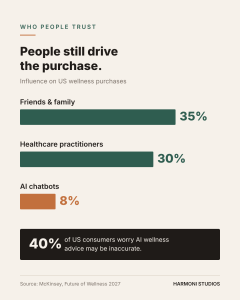
- 40% of US consumers worry AI health advice may be inaccurate.
- Only 14% of AI users said a chatbot led them to skip a doctor visit.
- US purchase influence: friends and family 35%, healthcare practitioners 30%, AI chatbots 8%.
Wellness Takeover and Discoverability
McKinsey advises brands to invest in generative engine optimization so they appear when AI agents curate options. It adds that discoverability alone will not overcome skepticism. Brands should make it easy to verify where a recommendation comes from.
Wellness Takeover Trends to Watch
- GLP-1 ecosystem. Among users, 35% eat more protein, 19% added supplements, and 18% began strength training. The Studio covers the beauty side in GLP-1 skincare: the ecosystem.
- Wearables. US adoption of wellness-first wearables is steady near 29%. Growth is in paid add-ons: up to half of users pay for premium services such as biomarker testing.
- Recovery. Cold plunges and social saunas are in the high single digits to high teens in US usage, and up to three-quarters of users plan to maintain or increase it.
- Biohacking. 18% of consumers are actively biohacking, 28% among Gen Z. Only 6% have tried peptide injections.
- Diagnostics. More than half of recent buyers of at-home labs and biomarker panels plan to spend more.
Wellness Takeover: What the Studio Reads
Three conclusions follow from the data.
- Wellness is a status language. Brands in fashion, beauty, travel, and dining are entering it, and the line between categories is dissolving.
- Proof is the entry fee. Claims without evidence will lose the spenders who matter most.
- Trust travels through people and sources. AI is a tool consumers use but double-check. Verifiable, sourced information is the differentiator.
One caution. McKinsey’s survey covers four markets and its US sample is 4,002 respondents. The figures describe those markets, not the world.
Wellness Takeover Sources
- McKinsey & Company, Future of Wellness 2027: Inside the $2.7 trillion takeover (Nov 3, 2026). Authors: Anna Pione, Eric Falardeau, Jonathan Medalsy, Kristi Weaver, Sara Hudson, Shaun Callaghan, Stefan Rickert.
- Glossy, The 5 consumer archetypes driving the $2.7 trillion wellness industry (Nov 4, 2026)
- Global Wellness Summit, Global Wellness News (Nov 5, 2026)