New York Longevity
New York longevity has a price list now, and I went looking for it. Under the clinics and the glowing saunas I found something far older. McKinsey just put numbers on the boom in its New York healthy-longevity report, and the numbers say the real market is not who you think.
New Y.ork Longevity Now Runs on Three Tiers
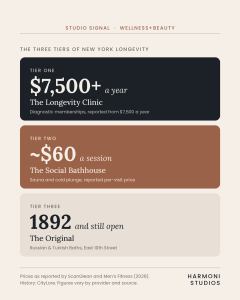
The city sells longevity at three very different prices. Most coverage stops at the first one.
Tier One: The Longevity Clinic Ladder
At the top sit the diagnostic clinics. Biograph, co-founded by Peter Attia, has a New York clinic with core membership reported from $7,500 a year. Fountain Life has a New York center too, and its entry pricing is reported anywhere from about $10,500 to $20,000 depending on the source. Skeptics point out that these services are mostly not covered by insurance and are not proven to extend lifespan. One cautionary tale: Modern Age raised $33 million, then shut abruptly in March 2024 before reopening.
Tier Two: The Bathhouse Boom in NYC Longevity
The louder story is happening in the sauna. Othership, Lore, AIRE, The Altar and Bathhouse are being called the city’s new nightlife: communal heat, cold plunges, no alcohol. Industry reporting says Othership’s Flatiron location draws up to 500 people a day. The rooms run low light with phones discouraged, and one session is reported at around sixty dollars.
Tier Three: The 1892 Original Longevity Ritual
Then there is 268 East 10th Street. The Russian & Turkish Baths have been operating since 1892. In the 1890s it was one of about sixty private bathhouses in the city, many used by Eastern European Jews. The last free public bathhouse closed in the 1970s. The ritual was never new. Only the membership is.

What McKinsey Found About New York Longevity Spending
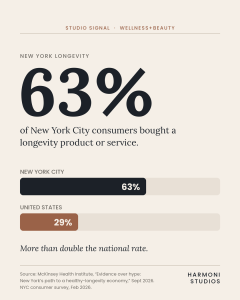
McKinsey surveyed about 2,800 adults in New York in February 2026. The headline: 63% of New York City consumers bought a longevity product or service, versus 29% nationally.
The Longevity Buyer Is Not the Billionaire
High spenders, defined as $225 or more a month, are a third of New Yorkers but 64% of longevity spending. And 83% of them live in households earning under $200,000. This market is carried by the stretched middle, not the elite.
Evidence Lifts Longevity Sales, Not Prices
When an offering showed evidence it worked, the share saying they would definitely buy rose by 11 points. But New Yorkers did not agree to pay more for it. Proof is the price of entry, not a luxury upgrade.
Why Social Health Anchors NYC Longevity
Sixty-nine percent of New Yorkers rate social health very or extremely important, about ten points above the national figure. Read that beside the bathhouse lines and the boom stops looking like a sauna trend. It looks like a loneliness trade.
The Healthy Longevity Gap Under the Boom
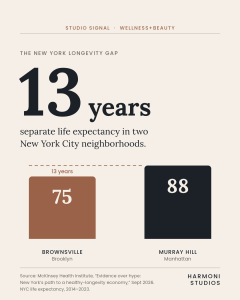
Thirteen Years Between Two ZIP Codes
McKinsey cites city data showing life expectancy of 75 in Brownsville, Brooklyn, and 88 in Murray Hill, Manhattan, across 2014 to 2023. Demand for longevity is high everywhere. Access is not.
Midlife Women: Paying In, Falling Behind
Women aged 45 to 55 are roughly ten to thirteen points less likely than other women to rate their physical, mental and social health as excellent or very good. Women also name affordability and missing insurance coverage as barriers more often than men do.
Appearance: The Least Proven Longevity Claim
Fifty-two percent of New Yorkers say longevity includes keeping their appearance as they age, against 44% nationally. McKinsey itself flags appearance as the least evidence-rich corner of the market. That is where the beauty lane lives, and where I would read every claim twice.
Where New York Longevity Science Meets the Stage
The Summit Panel, in Plain Terms
McKinsey presented the research at its fourth Future of New York Summit. The panel paired Harvard geneticist David Sinclair, Novo Nordisk US Operations chief Jamey Millar and Tony winner Sutton Foster, moderated by TIME’s Alice Park. McKinsey staff describe the conversation as covering evidence versus hype, access, and longevity as an economic engine for the city.
The Treatment Behind the Headline
The science on that stage is early. Sinclair’s company, Life Biosciences, received FDA clearance for the first human trial of partial epigenetic reprogramming, with the first participant dosed in June 2026. The therapy, ER-100, targets optic neuropathies and is a Phase 1 safety study. It is not a general anti-aging treatment. Critics, including a June 2026 New Yorker essay, argue the proven gains still come from the basics: movement, food, sleep, relationships and healthier neighborhoods.
New York Longevity Seen From the Foothills
I watch this from the Appalachian foothills, where Harmoni sits. No one sells a membership to a porch. The walk to a neighbor’s house has no booking page. I will not romanticize a region with its own health gaps. But I notice that the city’s most expensive new product, a warm room and a stranger to talk to, is the oldest longevity habit there is.
New York is the marketplace. It prices what everyone already needs, and then it measures who can afford it.

The Signal: What New York Longevity Is Really Selling
- Connection is the product. The boom tracks a city that rates social health above the national norm.
- Proof converts. Evidence moves buyers, but it does not move prices.
- The gap is the story. A thirteen-year ZIP code divide and a midlife women’s gap sit under the glow.
I will keep watching where the city’s longevity money goes next, and who gets left outside the door.
Sources Behind This New York Longevity Signal
- McKinsey Health Institute: Evidence over hype, New York’s path to a healthy-longevity economy (Sept 30, 2026)
- Avenue Magazine: The New Nightlife (Oct 2026)
- Men’s Fitness: The Wellness Center Is Becoming the New Nightclub (Jul 2026)
- Beauty Matter: Inside the Boom of Social Wellness Clubs
- CityLore: Russian & Turkish Baths
- ScanGlean: Best Longevity Clinics in the US (2026)
- Yahoo Lifestyle: Are Longevity Clinics Worth It in 2026?
- Nature Biotechnology: FDA go-ahead to test cellular rejuvenation therapy in humans (2026)
- Dhruv Khullar, The New Yorker: Something Is Very Wrong with Modern Longevity Science (Jun 2026)