Built For Heat
France prices fragrance through scarcity. India prices it through climate.
In France’s Two Luxuries, I wrote about value moving through access — who could get the bottle, how limited the run. That logic assumes a fragrance built for a cool room, unfolding slowly over hours undisturbed by heat.”It’s the real version of the attar vs perfume debate — not a marketing angle, but a genuine difference in what each fragrance is built to survive.
I don’t think that assumption survives a Delhi afternoon, and I don’t think Indian fragrance culture — built for heat, not scarcity — was ever designed to make it..
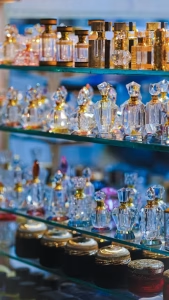
The imports still move — Dior Sauvage, Bvlgari, Jo Malone, Tom Ford all hold real shelf presence in Mumbai and Delhi boutiques, and I don’t discount that. But I’ve noticed the imported bottle isn’t the whole story anymore. A new generation of Indian houses is being named alongside them, not underneath them — NEESH, with a documented lineage back to 1904, working in Extrait de Parfum concentration; Naso Profumi, pairing attar-house rose and mitti with bergamot and tamarind; The Perfumatory, built specifically because founder Jay Vira noticed most imported fragrance simply failed to perform in Indian heat, and engineered oil-heavy concentrations to fix it.
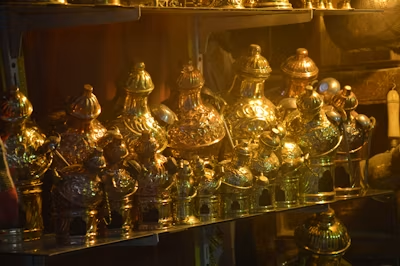
Then there’s the older lineage underneath all of it — houses like Gulabsingh Johrimal, distilling in Delhi since 1816, still working the same deg-and-bhapka copper method their name has carried for two centuries.
A French niche fragrance is built to unfold — top notes giving way to a dry-down that can take hours, in a climate cool enough to let that happen undisturbed. Heat doesn’t allow the patience. It burns off top notes almost immediately.
So the Indian houses built differently, and I think this is the part the West keeps missing: value here isn’t measured by how a fragrance unfolds. It’s measured by whether it’s still true to itself eight hours later. That’s a different craftsmanship problem entirely — and it’s exactly what The Perfumatory’s high-concentration formulas and the old attar houses’ oil-based, alcohol-free builds are actually solving for.
I don’t think this is imposed on buyers from the outside — it’s what they’re actually asking a fragrance to do. Does it survive the heat, does it hold through a full day, does the richness register through humidity instead of getting lost in it. A fragrance that fades by noon has failed at its one job, whatever name is on the bottle.
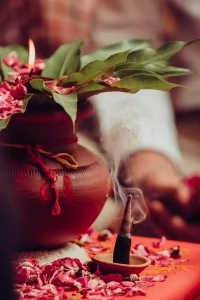
And there’s something quieter underneath that I keep noticing in the attar tradition specifically — a lot of these scents aren’t chosen to be noticed by a stranger. They’re chosen because they’re the smell of a specific festival, a specific relative’s home. That’s a value system built on memory, not signaling. It doesn’t need scarcity to matter.
France asks a fragrance to be rare. India asks it to survive the day and still mean something by evening. I don’t think one is a lesser system — they’re built for different climates, different relationships between scent and self. What I’d watch for next is a Western house discovering attar the way they’ve discovered everything else — repackaging the craft, missing the actual logic underneath it. NEESH and The Perfumatory suggest that story might not play out the same way this time. The houses making the case for their own tradition are already the ones with the strongest names on the shelf.
— Hana